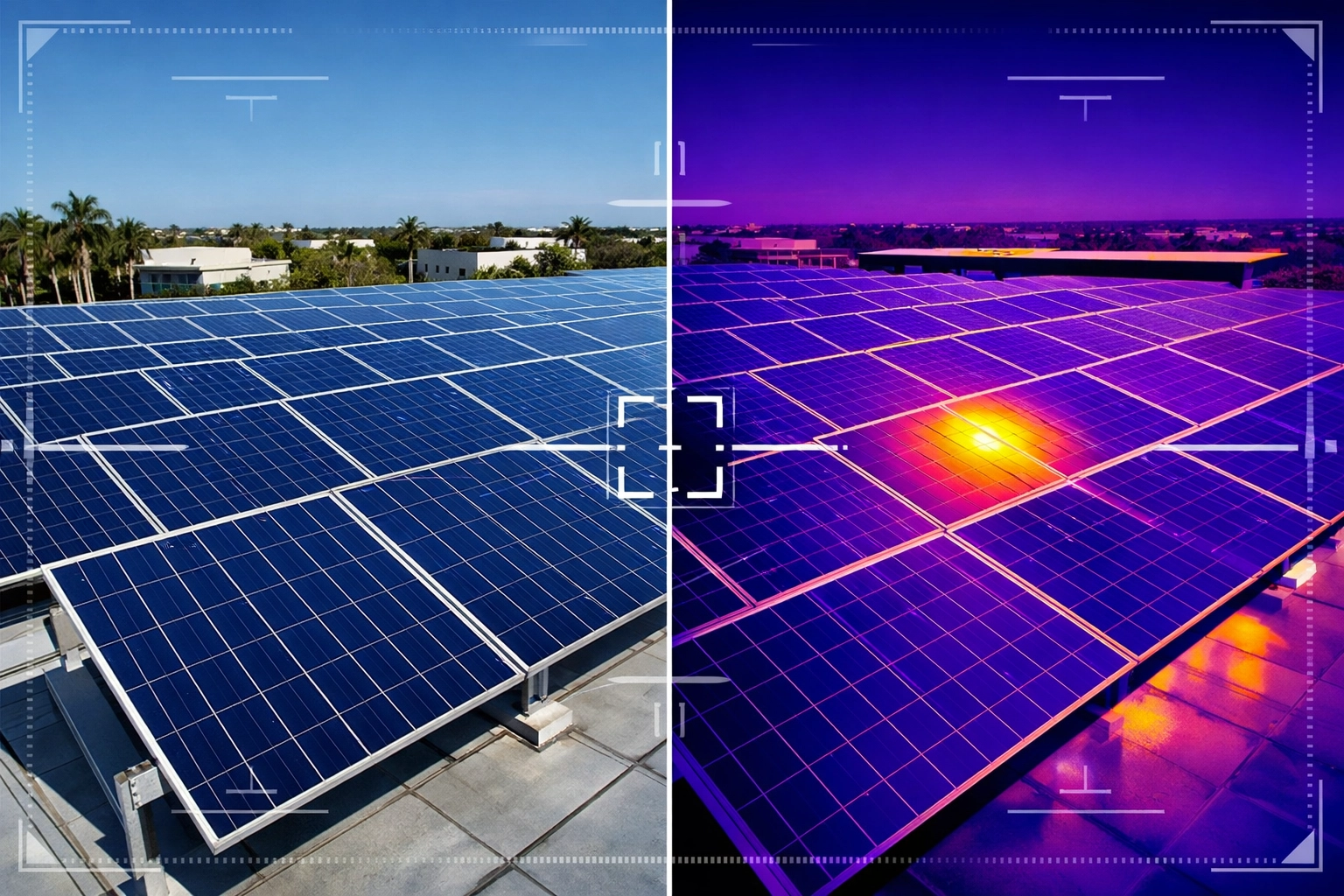
Thermal drone inspections utilize high-resolution infrared sensors to detect temperature anomalies across photovoltaic (PV) arrays: identifying performance-limiting defects that remain invisible to the naked eye. In the high-heat environment of Southwest Florida, these anomalies often signal localized cell failures, wiring issues, or environmental degradation that can significantly impact the total power output of a commercial solar installation.
By leveraging advanced aerial platforms, Cape UAV provides asset managers in Cape Coral and Fort Myers with a data-driven method to audit system health without the safety risks or time constraints of manual, ground-based testing. This proactive approach transitions maintenance from reactive troubleshooting to a strategic performance-recovery model.
High-Resolution Thermal Analysis: The Autel EVO Lite 640T Advantage
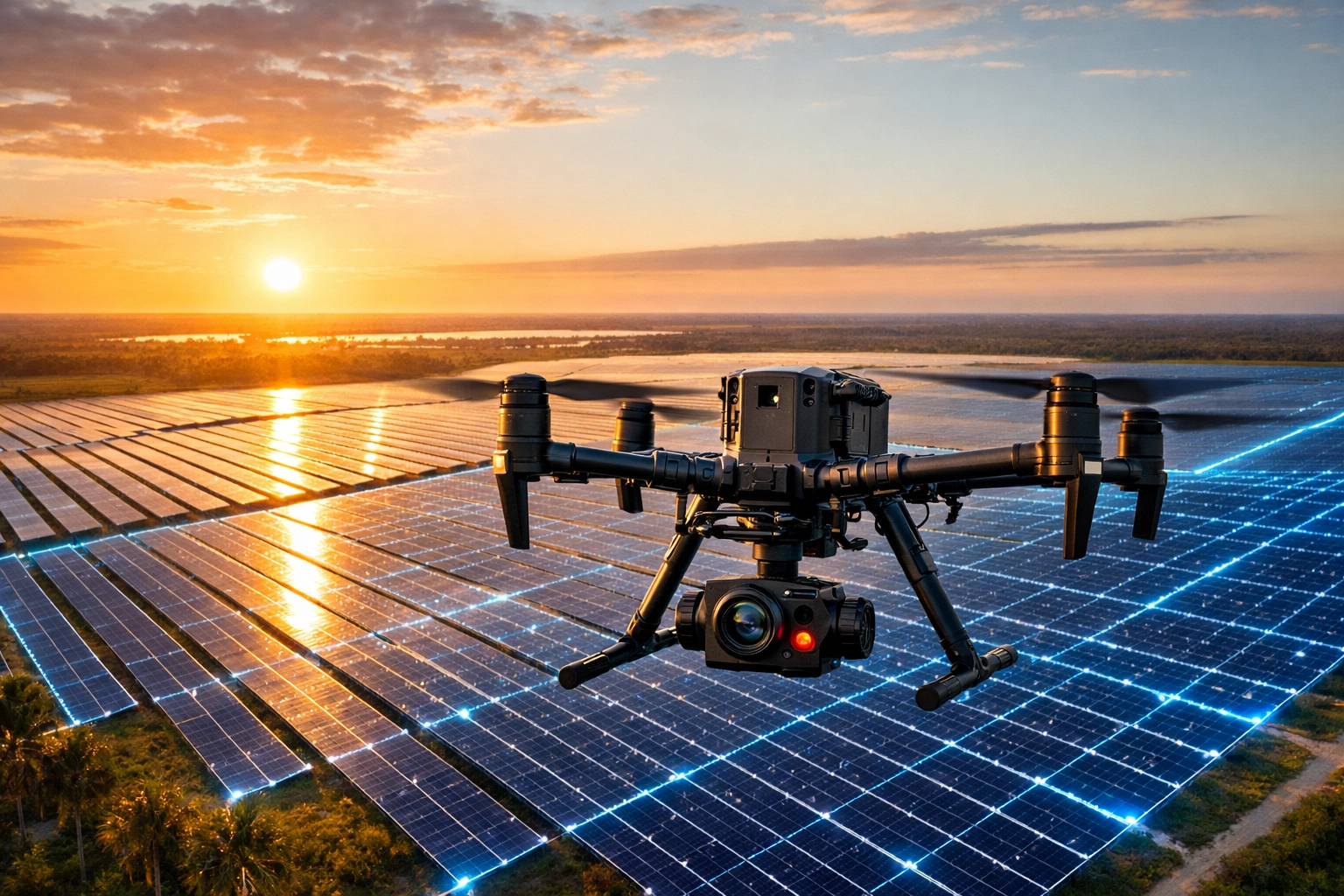
The effectiveness of a solar inspection is directly tied to the resolution of the thermal sensor: the higher the pixel count, the more accurate the temperature data at range. Cape UAV utilizes the Autel Robotics EVO Lite 6T Enterprise (EVO Lite 640T) to deliver precision imaging that meets industry standards for commercial PV auditing.
Equipped with a 640×512 thermal sensor and a 50MP visual camera, this platform allows for the simultaneous capture of infrared and high-definition visual data. This dual-stream capability is essential for correlating a thermal "hotspot" with its physical cause: such as a cracked glass panel, bird droppings, or internal cell delamination.
Why Resolution Matters
- Precision Detection: The 640×512 sensor provides four times the detail of entry-level 160×120 sensors, ensuring that individual cell defects are visible even from safe flight altitudes.
- Radiometric Measurement: Every pixel in the image contains temperature data, allowing for exact "delta-T" (temperature difference) calculations between functioning and non-functioning components.
- Efficient Coverage: Higher resolution allows the drone to fly higher while maintaining the ground sample distance (GSD) required to identify small anomalies: speeding up the data collection process for large-scale arrays.
Autel Robotics is a trademark of its respective owner; Cape UAV is not affiliated with or endorsed by Autel Robotics.
Identifying Efficiency Gaps: From String Failures to Hotspots
Solar panels operate at peak efficiency when current flows uniformly across the entire array. When a component fails or is obstructed, that energy is often dissipated as heat: creating a thermal signature that can be mapped and analyzed.
Detecting String Failures
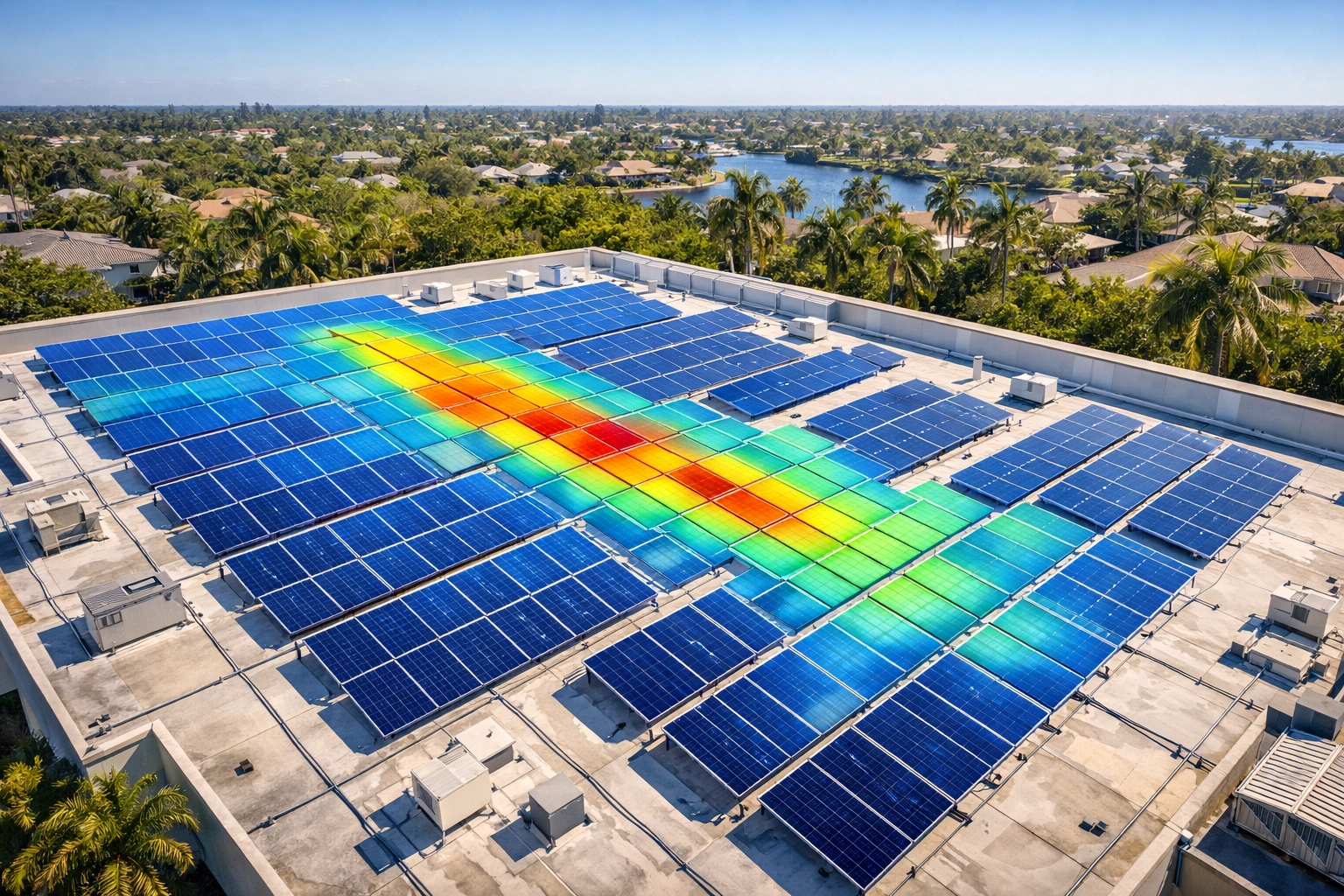
A string failure occurs when an entire row of panels stops contributing power to the inverter, often due to a blown fuse, disconnected wiring, or a failed combiner box. On a thermal map, a failed string appears as a uniform, slightly warmer block of panels compared to the active surrounding strings. Identifying these gaps early allows for immediate electrical remediation, restoring significant portions of the system's output.
Identifying Cell Defects and Hotspots
Individual cell defects: often caused by manufacturing flaws or micro-cracks: create localized hotspots that can reach temperatures high enough to damage the panel’s backsheet. These defects not only reduce the efficiency of the specific panel but can also trigger bypass diodes, essentially taking a portion of the module offline.
Why This Matters:
- Early Intervention: Detecting a failing bypass diode before it melts prevents potential fire hazards and localized equipment damage.
- Warranty Documentation: High-resolution thermal imagery provides the empirical evidence required to submit manufacturer warranty claims for defective modules.
- Predictive Maintenance: Monitoring the progression of "hot" cells allows for scheduled replacements during planned downtime rather than emergency repairs.
Southwest Florida Environmental Factors: Cape Coral and Fort Myers
The climate in Southwest Florida presents unique challenges for solar performance. High humidity, salt air, and intense UV exposure accelerate the degradation of electrical connections and panel seals. Furthermore, the region's frequent storms can deposit debris or cause subtle physical impacts that lead to micro-cracking.
Heat-Induced Degradation
In the intense sun of Fort Myers, solar panels already operate at high base temperatures. When a panel develops an efficiency gap, the resulting heat accumulation is exacerbated by the ambient environment, leading to faster component failure. Thermal drone inspections identify these opportunities for efficiency by highlighting modules that are operating significantly above their designed thermal threshold.
Environmental Soiling and Shading
Dust, pollen, and salt film can create "soiling" patterns that obstruct light and create cooler regions on a panel: indicating a need for cleaning. Conversely, shading from nearby structures or overgrown vegetation creates localized cooling that restricts current flow. Our industrial drone services help site managers distinguish between environmental soiling and true hardware failures.
ROI Advantage: The Financial Case for Aerial Inspections
Traditional solar inspections involve technicians walking the site with handheld thermal cameras or multimeters: a process that is time-consuming, labor-intensive, and prone to human error. Aerial thermal imaging transforms the ROI of solar maintenance by reducing inspection time and identifying more points of failure.
| Feature | Traditional Manual Inspection | Cape UAV Thermal Drone Inspection |
|---|---|---|
| Speed | 2–5 hours per Megawatt | ~10 minutes per Megawatt |
| Coverage | Spot-checking or partial sampling | 100% array coverage |
| Safety | High (walking roofs/near high voltage) | Low (remote aerial observation) |
| Data Quality | Subjective handheld photos | Radiometric, georeferenced maps |
| Cost | High labor costs | Up to 40% reduction in inspection spend |
Revenue Recovery through Data
The primary ROI of a thermal inspection is the identification of "lost" energy. If a 5MW array has a 3% failure rate due to undetected string outages or hotspots, the annual revenue loss can be substantial. By identifying these gaps and facilitating repairs, the inspection often pays for itself within the first few months of restored production.
Operational Cost Savings
Reducing the time spent on-site by maintenance crews lowers operational overhead. Instead of searching for a fault, technicians are dispatched directly to the georeferenced location of the anomaly: minimizing diagnostic labor and getting the system back to peak performance faster. For more information on how we support large-scale sites, visit our drone services page.
Integration with Industrial Workflows
The data captured by the Autel EVO Lite 640T is more than just a picture; it is a digital asset that integrates into broader site management strategies. Cape UAV provides high-resolution thermal orthomosaics: stitched maps that provide a complete, bird’s-eye view of the entire solar facility.
This mapping capability allows for:
- Historical Benchmarking: Comparing thermal maps over time to track the degradation rate of the array.
- Punch-List Generation: Creating precise maps for repair crews to follow during maintenance cycles.
- Site Documentation: Providing stakeholders with a visual record of asset condition for insurance and valuation purposes.
To understand the difference between these mapping deliverables, you can explore our guide on orthomosaic vs 3D modeling.
Important Disclaimer
Thermal results indicate anomalies and are not a substitute for evaluation by a licensed professional. Cape UAV provides data for planning and documentation purposes; all electrical repairs and official system certifications should be performed by a licensed solar contractor or electrician.
Securing Long-Term Solar Performance
In Southwest Florida, the transition to solar energy is a significant capital investment. Protecting that investment requires more than just visual monitoring; it requires a technical understanding of how heat patterns correlate with electrical performance.
By identifying efficiency gaps early: before they escalate into system-wide failures: Cape UAV provides commercial property owners and solar operators in Cape Coral and Fort Myers with the clarity needed to maintain peak output. The combination of the Autel EVO Lite 640T’s 640×512 thermal sensor and our specialized flight protocols ensures that no defect goes undetected.
If you are looking to support your solar array’s performance and reduce long-term maintenance costs, contact us today for a technical consultation or a quote for your next inspection.
Important Disclaimer: Thermal results indicate anomalies and are not a substitute for evaluation by a licensed professional. Our data is for planning purposes and is not a substitute for a licensed land survey. Cape UAV is a provider of aerial imaging and drone services focused on technical excellence in Southwest Florida.