Commercial roof systems represent one of the most significant capital expenditures for property managers and Homeowners Associations (HOAs). In the volatile climate of Southwest Florida: specifically across Cape Coral and Fort Myers: roofing membranes are subjected to extreme thermal cycling, high humidity, and intense solar radiation. These conditions accelerate material degradation, often leading to subsurface moisture intrusion that remains invisible to the naked eye until catastrophic failure occurs.
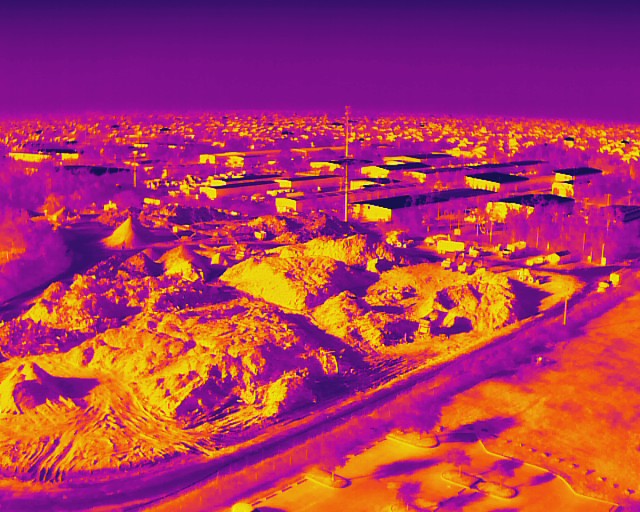
Thermal drone inspections leverage infrared thermography to detect temperature anomalies on the roof surface. This technology identifies trapped moisture within the insulation or substrate long before leaks manifest inside the building envelope. By capturing the "thermal signature" of a structure, Cape UAV provides stakeholders with the data necessary to make informed maintenance decisions.
The Technical Edge: Autel EVO Lite 640T Precision
The efficacy of a thermal inspection is directly tethered to the resolution of the infrared sensor. Cape UAV utilizes enterprise-grade equipment, including the Autel Robotics EVO Lite 6T Enterprise (EVO Lite 640T), to deliver high-fidelity data. This platform features a 640×512 thermal sensor: a critical specification that provides four times the pixel density of standard 160×120 or 336×256 sensors.
Higher resolution is not merely a luxury; it is a technical requirement for identifying subtle insulation gaps and small moisture pockets. The 640×512 sensor allows our pilots to maintain a safe flight altitude while capturing granular detail: ensuring that even minor thermal bridges are documented. Coupled with a 50MP visual camera, this dual-sensor approach provides a comprehensive view of both the structural integrity and the thermal performance of the asset.
The Science of Thermal Mass and Moisture Detection
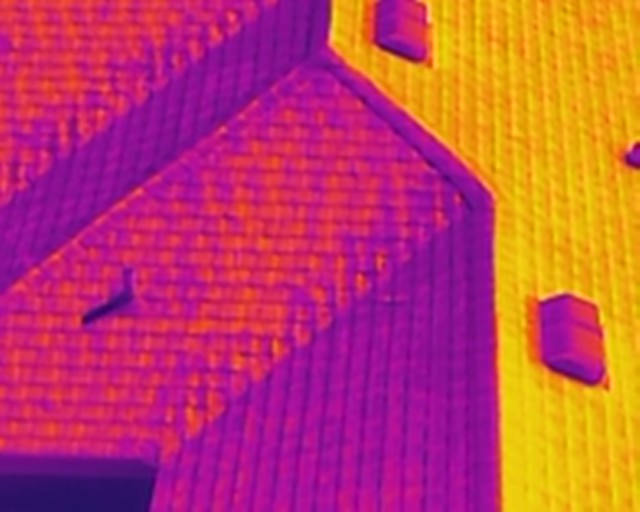
Thermal moisture detection relies on the physical principle of thermal mass. Water has a much higher heat capacity than standard roofing materials like TPO, EPDM, or modified bitumen. During a typical Southwest Florida day, the sun heats the entire roof surface. As evening approaches and the ambient temperature drops, dry roofing materials cool down rapidly: releasing their stored energy into the atmosphere.
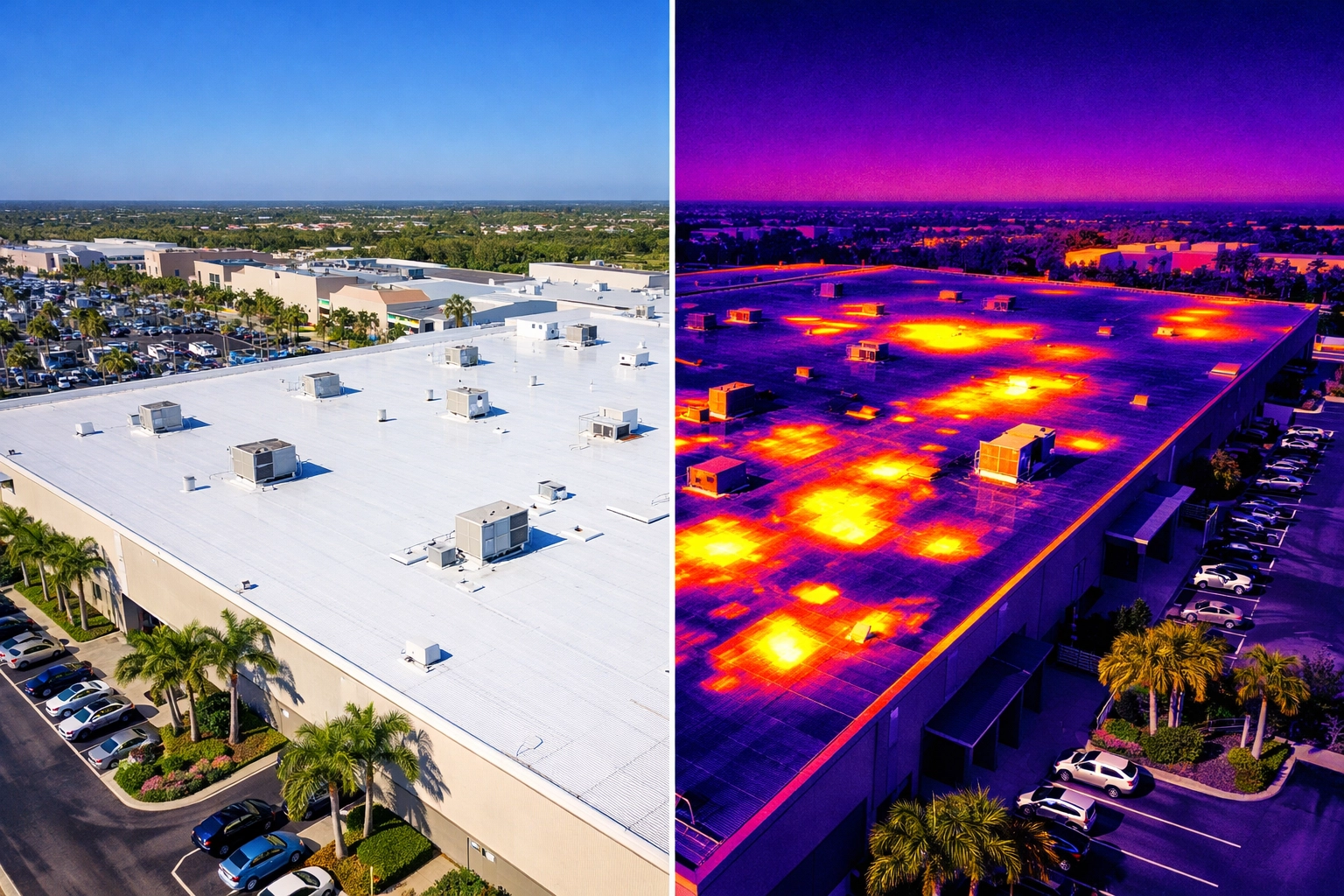
Wet insulation behaves differently. Because water retains heat significantly longer than dry material, areas of moisture intrusion stay warm long after the rest of the roof has cooled. Our thermal drones capture this "thermal lag": revealing bright "hot spots" on the infrared spectrum that correlate exactly with subsurface water entrapment.
Conversely, in certain environmental conditions, evaporative cooling can cause wet areas to appear cooler than the surrounding dry roof. This reversal depends on the rate of evaporation and internal building temperatures. The expertise of the thermographer lies in interpreting these patterns: distinguishing between actual moisture intrusion and common roof features like internal drains, HVAC exhaust, or structural supports.
Why HOAs and Property Managers in Southwest Florida Need Thermal Data
For property managers in Fort Myers and Cape Coral, the coastal environment poses unique challenges. Salt-laden air and high-velocity wind events can create micro-fractures in roofing membranes. Once moisture bypasses the primary membrane, it begins to saturate the insulation boards: compromising the building’s R-value and providing a breeding ground for mold.
Traditional "walk-over" inspections are inherently limited. They rely on physical signs of distress: such as soft spots or interior staining: which often indicate that the damage is already extensive. Thermal drone inspections eliminate the guesswork. We provide a non-destructive method to "see" through the membrane: identifying the exact boundaries of saturated insulation without drilling a single test hole.
Identifying Opportunities for Efficiency through Preventative Maintenance
A reactive approach to roof management is the most expensive strategy a commercial property owner can employ. Waiting for a leak to appear in a tenant’s space or a resident’s unit results in emergency repair costs, interior damage claims, and potential business disruption. By integrating annual or bi-annual thermal scans, managers can identify opportunities for efficiency regarding their long-term maintenance budgets.
Proactive thermal mapping allows for "surgical" repairs. Instead of replacing an entire 50,000-square-foot roof because of a few persistent leaks, owners can use thermal data to replace only the 500 square feet of saturated insulation and patch the specific entry point. This targeted approach preserves the functional life of the remaining dry roof components: delaying massive capital outlays by years or even a decade.
ROI Advantage: Extended Roof Life and Targeted Repairs
The Return on Investment (ROI) for thermal drone inspections is realized through the avoidance of premature total roof replacement. A full commercial roof replacement can cost hundreds of thousands of dollars. In contrast, a targeted repair informed by thermal data costs a fraction of that amount.
Consider the following ROI factors:
- Labor Savings: Drones can inspect a 100,000-square-foot facility in a single evening: a task that would take a ground crew days of manual moisture probing.
- Insurance Documentation: High-resolution thermal imagery provides an objective record of roof health: useful for validating insurance claims after storm events.
- Energy Savings: Saturated insulation loses its thermal resistance. By identifying and replacing wet sections, property managers support the building’s HVAC efficiency: reducing monthly cooling costs in the Florida heat.
- Safety: Eliminating the need for technicians to walk near roof edges or on potentially compromised surfaces significantly reduces liability and job-site risk.
Comparing Inspection Methodologies
| Feature | Traditional Walk-Over | Infrared Drone Inspection |
|---|---|---|
| Speed | Slow / Manual | Rapid / Automated |
| Safety | High Risk (Personnel on Roof) | Low Risk (Remote Operation) |
| Scope | Point-based / Limited | 100% Surface Coverage |
| Cost | High Labor | High Efficiency |
| Subsurface View | None (Visual only) | Clear (Thermal Signature) |
| Data Quality | Subjective Notes | Objective High-Res Imagery |
Technical Specifications for Enterprise Inspections
When selecting a drone service provider for industrial or commercial assets, the hardware matters as much as the pilot’s skill. At Cape UAV, our primary platform for these missions is the Autel Robotics EVO Lite 640T.
- Thermal Resolution: 640×512 VOx Uncooled Microbolometer.
- Visual Resolution: 50MP 1/1.28" CMOS sensor for correlating thermal anomalies with physical defects.
- Temperature Sensitivity: <30mk, allowing for the detection of even the smallest temperature differentials (The Delta T).
- Radiometric Data: Each pixel contains temperature data: allowing for post-flight analysis and precise reporting.
Note: Autel Robotics is a trademark of its respective owner; Cape UAV is not affiliated with or endorsed by Autel Robotics. Equipment performance is subject to environmental conditions and atmospheric interference.
Maximizing Asset Performance in Southwest Florida
The transition from reactive to proactive roof management is a hallmark of modern property administration. By utilizing drone services for thermal imaging, HOAs and commercial owners in Cape Coral and Fort Myers gain a competitive edge. You no longer have to wonder if your roof is failing; you have the data to prove its condition.
Whether you are preparing for a property transfer, conducting a post-hurricane assessment, or simply looking to identify opportunities for efficiency in your preventative maintenance schedule, thermal drone technology is the most effective tool available. It provides clarity, reduces risk, and ensures that your capital is spent on solutions: not just patches.
Important Disclaimer
Thermal results indicate anomalies and are not a substitute for evaluation by a licensed professional. Cape UAV provides data for planning and documentation purposes.
Secure Your Asset with Cape UAV
Don't wait for the next heavy Florida downpour to discover a roof failure. Identifying moisture intrusion early is the only way to protect your building’s structural integrity and your organization's bottom line. For more information on how we support industrial and commercial properties with aerial imaging, contact Cape UAV today.
Important Disclaimer: Thermal results indicate anomalies and are not a substitute for evaluation by a licensed professional. Our data is for planning purposes and is not a substitute for a licensed land survey.