For property managers in Southwest Florida, the building envelope is the first and most critical line of defense against an unforgiving environment. The combination of intense sub-tropical heat, high humidity, and seasonal hurricane-force winds places immense stress on commercial and residential structures alike. When this "outer shell" fails, the consequences are rarely immediate or visible to the naked eye; instead, they manifest as mounting energy bills, structural degradation, and costly mold remediation.
Traditional inspection methods often involve manual walk-throughs, scaffolding, or high-reach lifts: processes that are time-consuming, expensive, and limited by the inspector's physical reach. Thermal drone inspections have redefined this workflow, providing a non-destructive, data-driven method to visualize what is happening beneath the surface of a building’s exterior.
The Critical Role of the Building Envelope
The building envelope consists of all the physical components that separate the interior of a structure from the external environment. This includes the roof, walls, windows, doors, and foundation. In Southwest Florida, the envelope's primary job is to regulate temperature and manage moisture.
When the integrity of the envelope is compromised, the building experiences "pathology": a series of failures that escalate over time.
- Moisture Intrusion: Water entering through micro-cracks or failed sealants.
- Air Leakage: Conditioned air escaping, forcing HVAC systems to overwork.
- Thermal Bridging: Areas where heat is transferred directly through poorly insulated materials.
Detecting these issues early is the difference between a minor maintenance fix and a multi-million dollar capital expenditure.
The Science of Thermal Imaging in Property Management
Thermal imaging, or infrared thermography, detects the electromagnetic radiation emitted by objects. Because every material has a specific thermal mass and rate of heat dissipation, temperature variations: known as "thermal anomalies": reveal hidden defects.
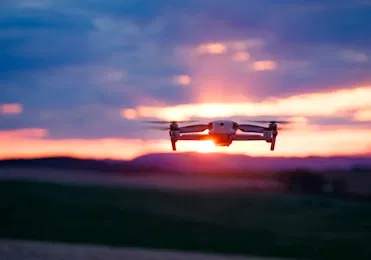
At Cape UAV, we utilize enterprise-grade technology, specifically the Autel Robotics EVO Lite 6T Enterprise (EVO Lite 640T). This platform features a dual-sensor payload: a 50MP visual camera for high-resolution documentation and a 640×512 thermal sensor. This high-resolution thermal sensor allows our FAA Part 107-certified pilots to identify temperature differences as small as a fraction of a degree from a safe distance.
Why Resolution Matters
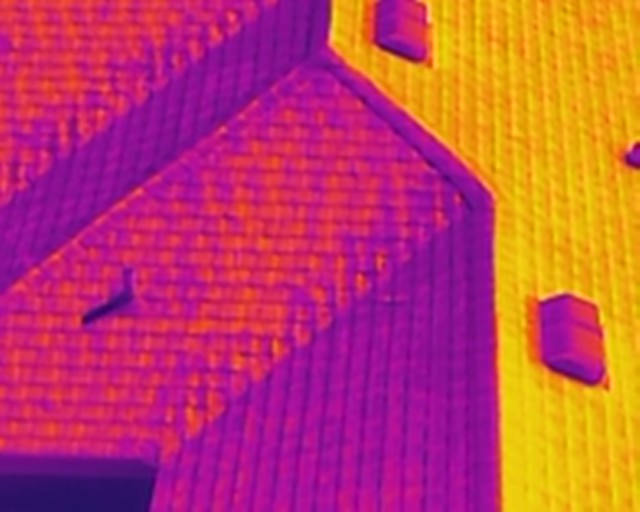
Lower-resolution thermal cameras often miss small leaks or localized insulation gaps. The 640×512 sensor on the EVO Lite 640T provides four times the detail of entry-level thermal drones, ensuring that even the smallest anomalies are documented for further professional evaluation.
Identifying Moisture Intrusion in Southwest Florida
Moisture is the single greatest threat to building longevity in Southwest Florida. Between the daily summer downpours and the high ambient humidity, any breach in the building envelope will eventually lead to water retention.
How Drones Detect Water:
Wet insulation and building materials have a higher thermal mass than dry materials. During the "diurnal swing": the period when the sun sets and the building begins to cool: wet areas retain heat longer than dry areas. On a thermal scan, these moisture-saturated spots appear as "hot spots" against the cooling dry surfaces.
Why This Matters:
- Mold Prevention: Identifying moisture before it penetrates the interior drywall prevents mold colonies from establishing.
- Structural Integrity: Constant moisture leads to the corrosion of metal fasteners and the rot of wood framing.
- Targeted Repairs: Instead of replacing an entire roof or facade, property managers can use thermal imaging data to pinpoint the exact location of the leak for surgical repair.
Energy Efficiency and Insulation Analysis
In a region where air conditioning accounts for the majority of a building’s operational costs, energy efficiency is a top priority for property managers and owners. Insulation failures and air leaks are often the primary culprits behind skyrocketing utility bills.
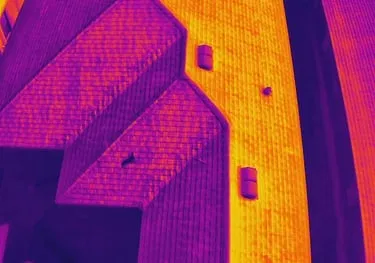
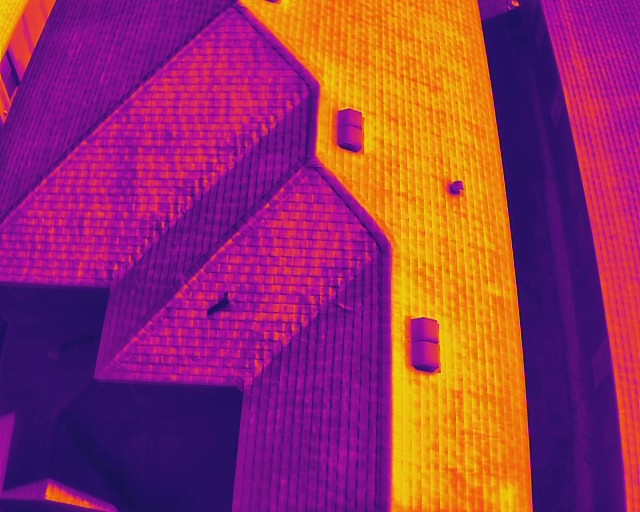
Thermal drone inspections allow us to visualize "energy bleed." When viewed through an infrared lens, air leaks around windows, doors, or parapet walls appear as plumes of temperature variation. Similarly, missing or degraded insulation in wall cavities or roof sections creates distinct thermal patterns that are invisible in the visual spectrum.
The ROI of Energy Audits:
By identifying opportunities to support energy efficiency, property managers can prioritize building upgrades that offer the fastest return on investment. Documenting these failures also provides the necessary evidence to hold contractors accountable for poor workmanship or material defects.
Drones vs. Traditional Inspection Methods
The transition from manual inspections to drone-based workflows offers significant advantages in safety, speed, and data quality.
| Feature | Traditional Manual Inspection | Cape UAV Thermal Drone Inspection |
|---|---|---|
| Safety | High risk (Ladders, scaffolding, lifts) | Minimal risk (Ground-based operation) |
| Speed | Days or weeks for large complexes | Hours for comprehensive data capture |
| Detail | Subjective, limited to reachable areas | Objective, 100% coverage of the envelope |
| Disruption | Significant (Tenant/business impact) | Minimal to zero disruption |
| Data | Written reports and handheld photos | High-resolution orthomosaics and thermal maps |
Safety and Accessibility
Many building features, such as high-rise facades or complex roof geometries, are difficult and dangerous to inspect manually. Drones eliminate the need for inspectors to put themselves in precarious positions. Our pilots can fly within meters of a structure to capture detailed data while remaining safely on the ground.
ROI: The Financial Case for Thermal Inspections
For a property manager, the cost of a thermal drone inspection is a fraction of the cost of a single major repair. The value is found in proactive maintenance.
- Extended Asset Life: By identifying and fixing minor envelope breaches, you extend the life of the roof and HVAC systems.
- Insurance Documentation: Following a storm or hurricane, having a pre-existing thermal baseline of the building envelope provides powerful evidence for insurance claims.
- Tenant Retention: Comfortable tenants are long-term tenants. Maintaining a consistent interior climate and preventing mold issues reduces tenant complaints and turnover.
- Due Diligence: For those looking to acquire or sell property in Southwest Florida, a thermal building envelope report provides an unbiased look at the structure's health, influencing negotiation and valuation.
Professional Standards and FAA Compliance
Operating a drone for commercial purposes in the United States requires strict adherence to FAA regulations. At Cape UAV, all missions are conducted by FAA Part 107-certified pilots. This certification ensures that our team understands airspace restrictions, weather impacts, and safety protocols necessary to operate in complex environments like Cape Coral, Fort Myers, and Naples.
Furthermore, using enterprise-grade equipment like the Autel EVO Lite 640T is not just about the camera; it’s about the reliability of the flight systems, the precision of the GPS, and the ability to operate in the challenging coastal winds of Southwest Florida.
Conclusion
The building envelope is a complex system that requires regular monitoring to ensure performance and longevity. In the Southwest Florida climate, waiting for a visible leak or a spike in the power bill means you are already behind the curve. Thermal drone inspections provide the clarity, confidence, and control property managers need to protect their investments.
Whether you are managing a single commercial facility or a large residential portfolio, integrated thermal data is the most efficient way to maintain building integrity.
Important Disclaimer
Thermal results indicate anomalies and are not a substitute for evaluation by a licensed professional. Our data is for planning and documentation purposes and is not a substitute for a licensed land survey. Cape UAV provides high-resolution aerial data and thermal imaging for informational purposes only.
About Cape UAV
Cape UAV is a premier provider of drone services in Southwest Florida. We specialize in high-resolution aerial mapping, industrial inspections, and thermal imaging. Our mission is to provide property managers, developers, and construction professionals with the technical data they need to make informed decisions.
For more information on our thermal capabilities or to schedule an inspection, visit our Contact Page.
Important Disclaimer: Cape UAV provides high-resolution aerial data and thermal imaging for informational and documentation purposes only. We are not a licensed professional land surveying or engineering firm and do not provide those services. Autel Robotics is a trademark of its respective owner; Cape UAV is not affiliated with or endorsed by Autel Robotics.